
Demonschool is one of my most anticipated games this year. I remember seeing the reveal trailer during 2022’s PC Gaming Show, and it grabbed my attention due to its resemblance to the early Persona games. From the trailers that followed, it seemed like another in a long list of “almost spiritual successor” games like Stardew Valley, Harvest Moon, or Wargroove to Advance Wars. Titles inspired by games developers wanted to see a sequel to, got tired of waiting, and did it themselves.
The original PlayStation Persona games are my usual go-tos when asked which classics I’d like to see remade, so I was excited to see someone else playing with the formula. Imagine my surprise, then, when I finally played it and realised my assumption was wrong. Demonschool has more in common with Paper Mario: The Origami King, Super Hot, and Chess than with Atlus’s flagship franchise.
Developed by Necrosoft, Demonschool is a story-heavy RPG with simple-to-use but hard-to-master turn-based tactical combat and undemanding relationship management. You play as Faye, a young demon hunter attending college on the mysterious Hemsk Island, fighting to stop the apocalypse. Along her journey, she’ll make friends and enemies, fight demons and gangsters, and try to solve the island’s mysteries.
The story is told over 10 in-game weeks, each one packed with story, combat, side quests, and social activities to grow your friendships. Gameplay is split between exploring the island and fighting demons, and there are a lot of demons to fight. Each day is divided into Morning, Evening, and Night during which you explore the island, take on side quests, and hang out with your mates. At the end of the week, you fight a boss and take an exam (just like in real school).
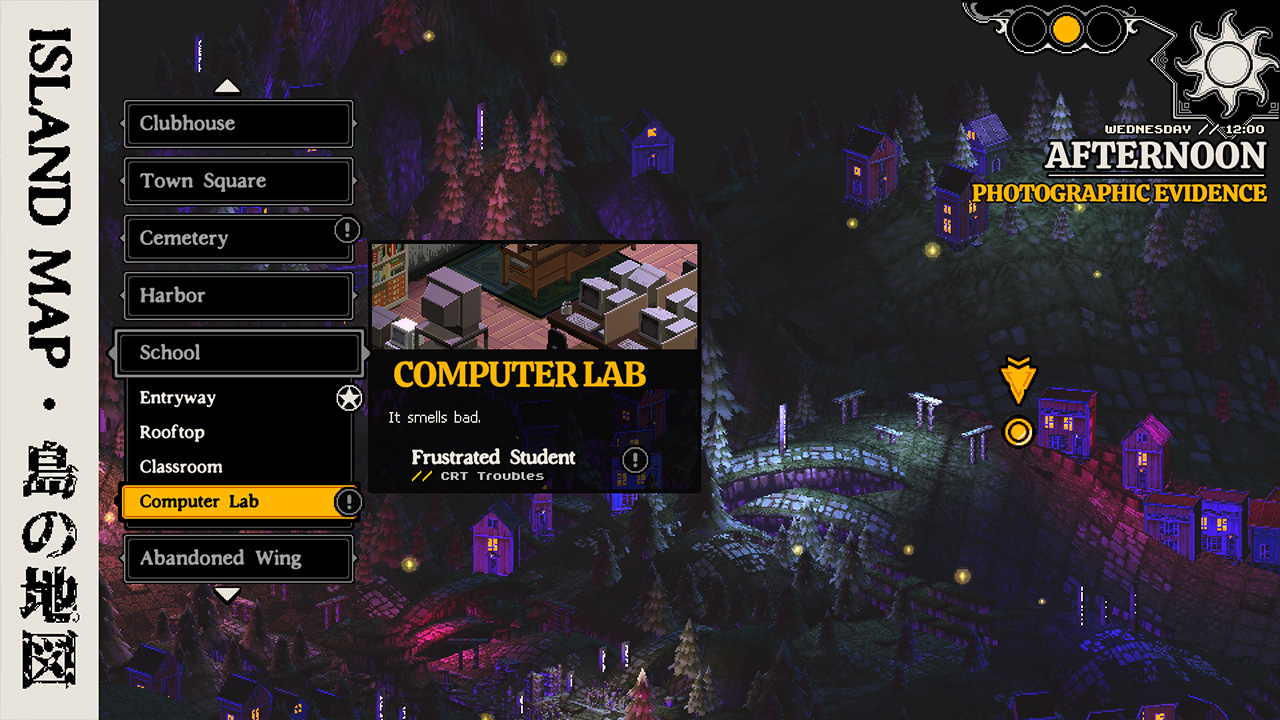
Exploring the island is limited. You choose your destination from a menu screen, then you’re free to run around the small area, talking to NPCs and interacting with the environment. Activities and quests are clearly marked with icons next to destination names to stop you from aimlessly checking areas, and more locations become available as the story goes on. One thing Demonschool does well over games with similar systems is that time only moves forward when you choose to progress the story, so you’re free to spend time doing that day’s side quests or minigames without fear of missing something. Minigames are played with members of your party, and completing one increases their friendship gauge. Once that’s full, you do a special side quest with them to unlock the next friendship level and hopefully a new ability as a reward. Once a friendship is maxed out, you can choose whether to get off with them.
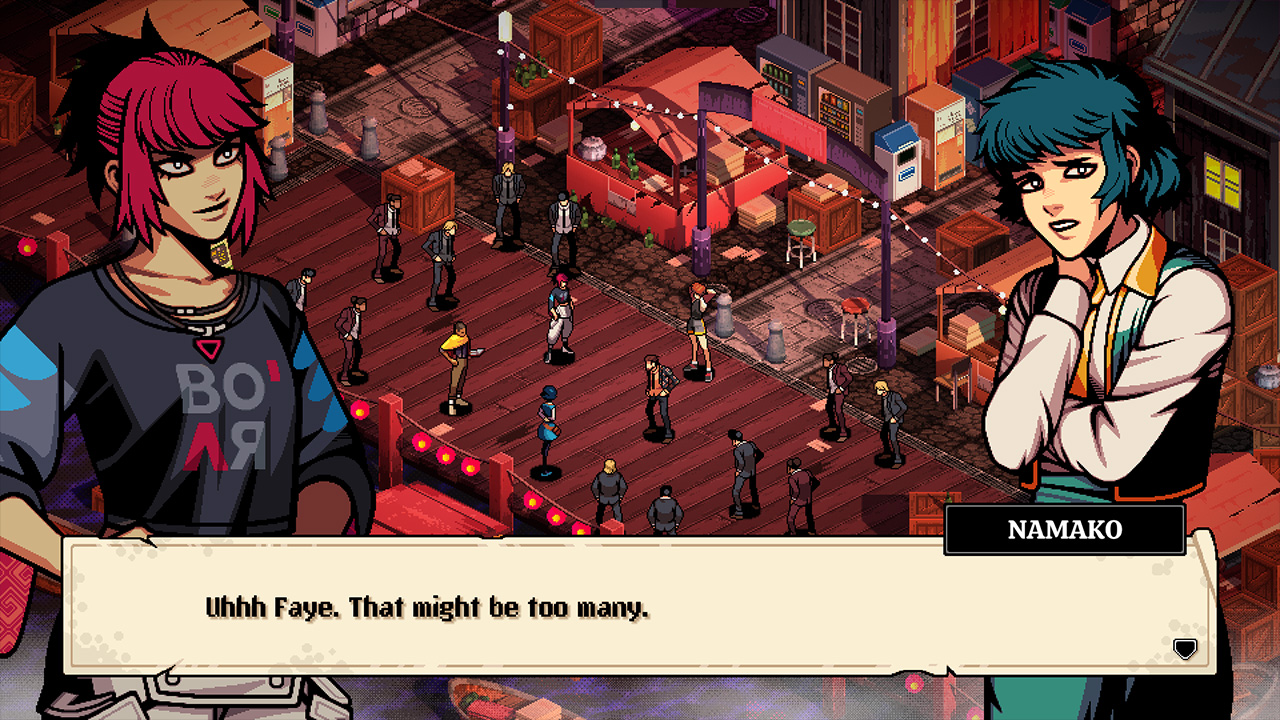
I need to be clear about something. I was playing the pre-release review build, and in it I could replay the minigames as many times as I wanted. Meaning I could spend a morning playing karaoke again and again, and maxing out several characters’ friendships in less than one in-game day. And by could I mean did. This is an oversight the developers are aware of and will adjust so that you can play each relationship point only once per day, giving the minigame once per day. I haven’t had a chance to experience it, and probably won’t, as it already took me around sixty hours to finish.
The minigames are fun and straightforward for a quick distraction, but I want to discuss the karaoke game briefly. When karaoke starts, you’re given a song topic like Fire, Water, Cat, etc. You’re then given three options, which act as the following line of the song, and you pick the one that contains your song topic before the time runs out. Super simple. However, I have ADHD with a touch of dyslexia, so the combination of trying to read prompts against a ticking clock caused my brain to short-circuit, and I’d often overlook the keyword due to panic reading. I had a better time playing on the Steam Deck because I could use the touchscreen, and knowing I had more time stopped my brain from scrambling, which made it possible to read correctly. I’m aware this is a me problem, but I know I’m not the only person whose brain is wired like this, so I wanted to highlight it as a potential issue for some players. One game I had a better time with was the cooking game, which sees you selecting symbols on a table with a moving arrow to match the ones pictured to make your partner’s dish. And yes, there is a fishing game.
Aside from the minigames, there are a ton of side, friendship, and story quests to do. Sadly, these are quite uninvolved and usually consist of running to a marker and reading dialogue, often making the game feel more akin to a Visual Novel than an RPG. But where those games often have rich stories and characters with mediocre combat, Demonschool does the opposite.
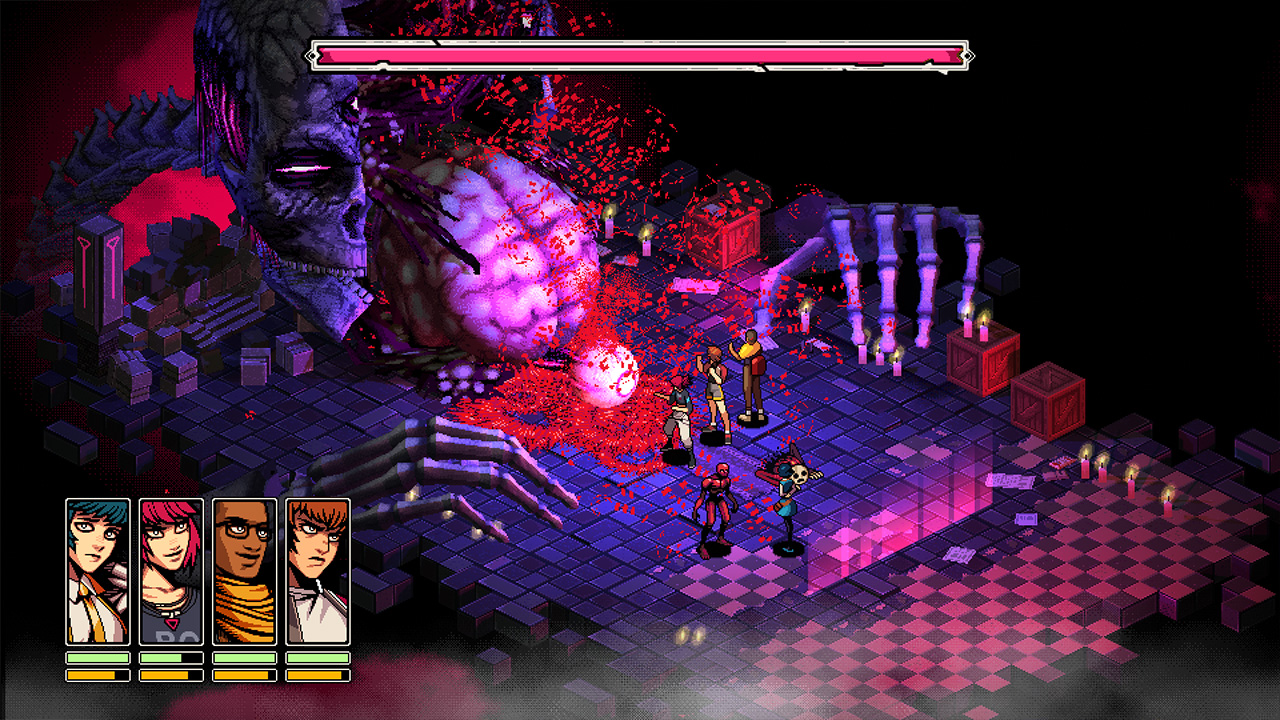
This game has one of the best and most interesting combat systems I’ve experienced in a long time, with fights playing out like a puzzle or a game of chess. Battles take place between the human and demonic spaces, which is the in-game reason for restricted movement and why the party heals after each battle. It’s an unnecessary detail, but one I appreciate.
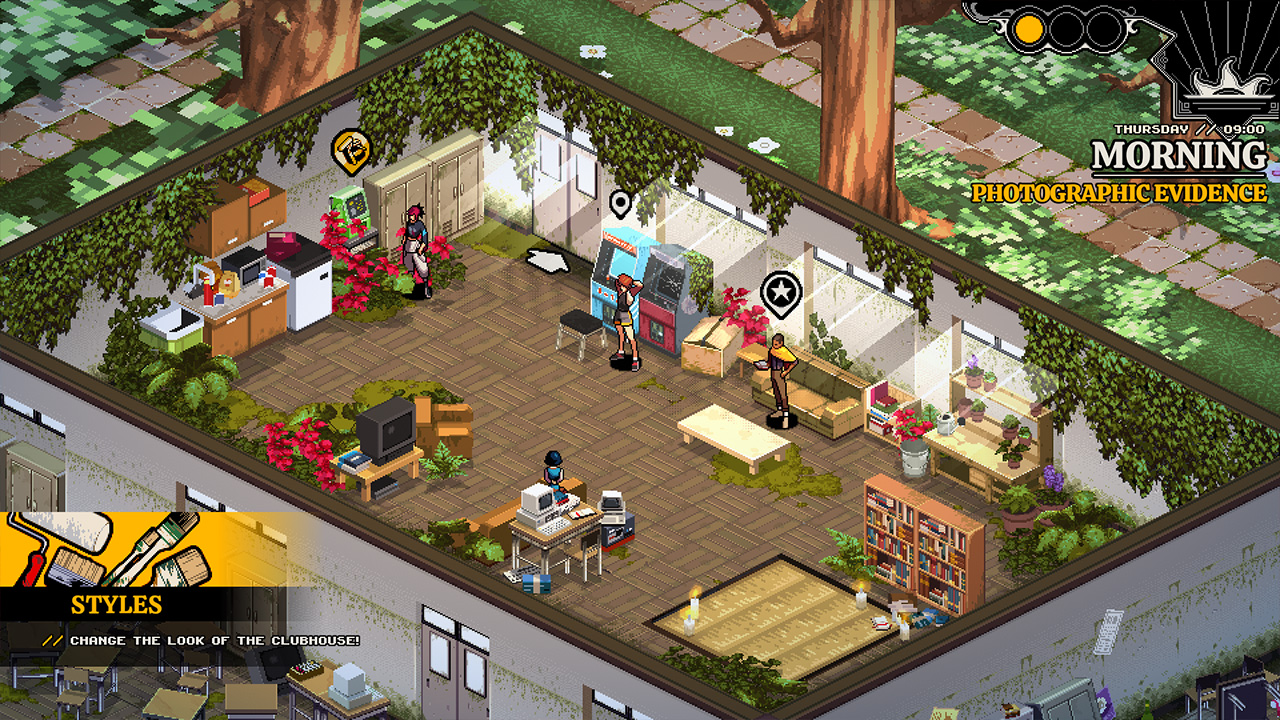
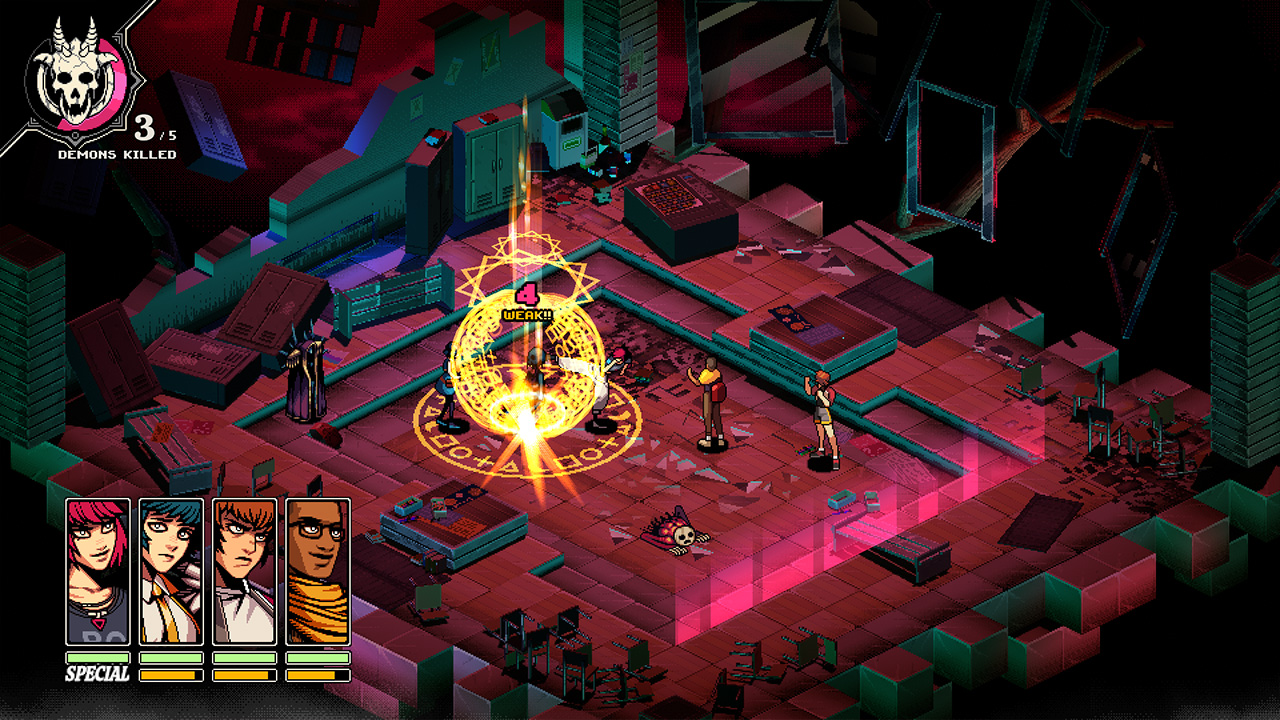
Each round is split into two phases: planning and action. During planning, you plan your party’s moves and actions, and when you’re happy, you lock it in and move to the action phase. Taking actions uses Action Points (AP) from a shared pool of eight. Each character’s first move costs one AP and goes up by one each time the character is used. For example, you can move each character once for a cost of four points, then move two characters one more time each for a total of six actions costing eight points. Or you can use one character three times for a total of six points, then use the remaining two points to move two other party members once each, for a total of five actions costing eight points. It depends on the situation and who’s at your party, and you don’t have to use all your AP. Working this out is a big part of the strategy and is a lot of fun.
During battle, your characters can only move in straight lines and diagonals, and they have to travel the full distance indicated by the highlighted tiles. Depending on the character and their abilities, they’ll automatically attack enemies, debuff them, or heal allies when moved into their targets. You can also perform a sidestep by selecting the tiles highlighted in blue, and an action that immediately follows a sidestep doesn’t cost AP, making it one of the most useful movements in the game.
Each character has their own attack style, which dictates how they’re used. For example, Faye deals one DMG and knocks enemies back one tile, whereas Namako passes through her targets and pulls them forward one tile while stunning them and reducing their defence. This is where the genius of the battle system comes into play. The key to winning is positioning characters and enemies to create combo attacks by pushing or pulling them into each other. Each character has an element assigned to them, and these elements make them strong or weak to certain enemies.
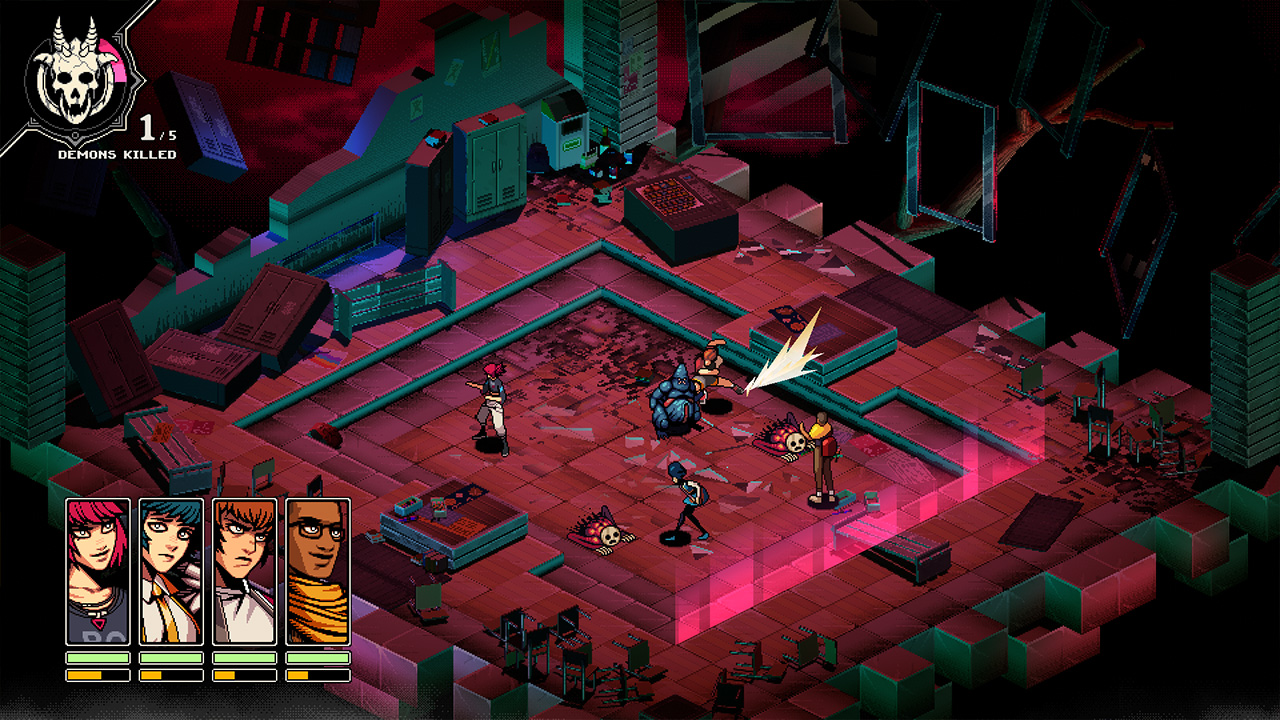
A party member’s normal attack is non-elemental, but their special attack and combos deal elemental damage. By performing a combo, both characters’ elements combine to make a new, more powerful element. For example, if a character with the flame element and one with the flood element perform a combo, the new element will be blood. It isn’t something I took much notice of until near the end of the game, when strengths and weaknesses became important, but it’s a system worth learning, and if mastered, you’ll be able to smash through enemies with no problems.
Each character also has a Special Skill that can be used when their SP meter is full. These moves can be game changers and have saved me more than once. Something else I love is that all the moves you take aren’t locked in until you choose to move to the action phase, so you’re free to rewind and try a different tactic. This means you’re free to make mistakes and experiment until you execute the perfect turn. Once you’re happy, you activate the action phase, which sees all characters and enemies return to their starting positions and play the battle out in real time. After the action phase, the enemy takes their turn, then your AP is replenished, and you get to go again.
Battles have win conditions, usually killing X number of enemies in X turns. Once the target has been reached, sigils at the top of the arena light up, and you win the battle by ending your turn with any of your characters on a sigil. But be warned, you’ll receive a Game Over if all player characters are killed or demons break the barrier at the bottom of the arena and pass through, which happened to me more than I care to admit. You’re ranked after each battle, and up to three class credits can be earned. But you’ll receive one less credit if a party member dies and one less if you don’t seal the portal before the target turn. Your rewards are determined by how many enemies you defeated, so you can either end the fight once the target is reached or, if you have enough moves left, kill a few more enemies before bailing out to increase your prizes.
This ranking system kicked my ass as I refused to move on unless I got an A rank. This self-imposed difficulty often saw me taking longer to work out and win battles against regular enemies than some bosses, as I’d retry again and again. The feeling of pulling off a perfect turn and sometimes finishing the fight a turn early was amazing. I can’t praise the battle system enough. It’s possible to progress with a basic understanding, but mastering movement and specials is what kept me playing for over 60 hours.
There are fifteen characters in total, which, if you ask me, is too many, but I grew up on Final Fantasy VII, so anything over nine party members is too much.
Faye is more or less the only constant character in your party, with the other three spaces free to pick at the start of each battle. Unless you do a character friendship quest, which sees them and Faye locked into the party, giving you two spaces to fill. Or various story missions, which can see your party formation locked. I’m not the biggest fan of this, as I like who I like, and being forced to use characters I dislike irks me. For example, there’s a character called Jem who comes across as a bigger sex pest than Teddy from Persona 4, and whenever I was forced to use them, battles stopped being fun. But since every character plays differently, I have to admit it was okay with being made to try out characters I’d have otherwise ignored. There’s even a point where every party member is used at once, and I ended up being grateful that I not only knew how to use them, but that I’d upgraded them too.
One of the most surprising aspects of Demonschool is that the characters don’t level up. There’s no EXP, no grinding, no numbers going up. Each character has three hit points, and most normal attacks deal one damage point, and I love it. Coming off RPGs where difficulty is tied to numbers, it was nice to play something tied to gameplay and problem-solving. Although they don’t level up, characters can be upgraded. Each party member can equip two skills and something called an Aspect Shift. Skills offer immunities to status ailments, add elemental resistance, or add damage modifiers or status ailments to attacks. Aspect Shifts change how that character plays, for example, allowing them to sidestep two tiles instead of one but reducing forward movement, or boosting attack if more than 10 enemies are on the field.
New abilities are given as rewards for finishing quests or can be bought from the store. But they cannot be equipped; once you receive them, you have to learn them first. This is done by selecting the ability you want to know, then selecting two party members to study together. This will make that ability available for any compatible character to equip. However, the characters that did the learning will rest for a few days, making them unable to learn anything again until they’re ready, stopping you from spamming learning abilities. I’m not a massive fan of this system, but I get it; the game is called Demonschool, so having to study to learn abilities makes sense. However, if I’ve just won a tough battle and received an ability as a reward, let me use it. Similarly, if I’ve saved a ton of Opals to buy a new ability, I don’t want to take extra steps to study it before I use it.
The study system is unbalanced and favours the back half of the game. Studying usually puts two characters out for four days. Meaning in the first week, you can only learn one ability because you only have two characters. Then, in week two, you have three characters, but again, you can only learn one ability, so the first few weeks are a slog with barely any abilities available. I don’t think I used any of them until week six, by which point I was over halfway through the game. At that point, new characters join at such a frequency that it’s possible to study for multiple abilities at once, and they start to unlock quickly, which is excellent for the back half but pointless for the front. It’s not the worst system; it just feels unnecessary and softlocks your party out of functional abilities until the endgame.
Demonschool is a very good game. In fact, it’s almost a great one. But if there’s one thing letting it down, it’s that the writing is cringingly bad. Anyone who remembers the mid-2000s will have stories about a girl at school or in their friend group who would describe themselves as “so random.” Now imagine if that girl grew up and joined an amateur improv group. That’s the level of writing here. The moment-to-moment stuff as the plot moves forward is fine. It’s not going to win awards, but it gets the job done. But the flavour text and character dialogue are awful. Characters are vapid stereotypes. For example, the first four characters you meet are the annoying, most likely undiagnosed ADHD girl, the goth girl from The Breakfast Club, the dumb guy who likes to hit things, and the nerd who only talks in movie references.
Writing is hard, especially for video games (which is why I don’t do it), and maybe it’s meta genius how the cringey dialogue is meant to replicate how we spoke in 1999, the year the game is set. But I doubt it. It has the same vibe as that cringey millennial core stuff on TikTok, and as an elder millennial myself, I’d like to apologise for these people… they don’t represent us all. There is one element of the writing, however, that I cannot criticise, and that is its representation of LGBTQ characters, of which there are a lot. Demonschool is a very gay game to the point I’m not sure there are any straight characters in the party. But what surprised me is that at no point is a character’s sexuality brought up as a personality trait. At one point, the party were talking to a new character, and they had been chatting for a while before I realised they were being referred to as they/them. They weren’t introduced as non-binary; the characters just knew which pronouns to use.
In a time where we have Dragon Age: The Veilguard and that whole scene, I found it refreshing. Also, none of the characters’ sexuality or pronouns is used against them. There’s no bullying for being gay; they’re just treated as people. I think the only time the word gay is mentioned is when one of the girls makes a quip about it rhyming with Faye, but she’d just kissed her, so I’m pretty sure that’s allowed. I’m a cis, straight male, so my experience with LGBTQ media is limited, but as a consumer of mainstream media mainly aimed at straight dudes, seeing this type of representation gives me hope that ‘inclusive’ won’t be treated as a bad word in the future. This is representation done right, and we need more writing like this.
I should also mention I encountered a ton of bugs and crashes during my playthrough, but the devs are aware of these issues. I even submitted a bug myself, and the devs got back to me, so I have confidence in their ability to fix the game.
So yeah, that’s my review of Demonschool. There’s probably more I could say, but then we’d be getting into the weeds, and this review is already too long and past due. Check it out, buy it, and support indie devs.
