
Since entering the public domain on 1st January 2022, Winnie the Pooh has appeared in several horror projects (most notably Winnie the Pooh: Blood and Honey), alongside indie games that lean heavily into schlock. So when I first saw Winnie’s Hole on Steam, I’ll admit I wasn’t impressed. That changed quickly when I discovered it was being developed by Twice Different, the creators of Ring of Pain. Suddenly, my scepticism turned into cautious optimism.
Thanks to my enjoyment of their previous game, I gave the demo of Winnie’s Hole a go and was quickly hooked. This is definitely not schlock. It’s an inventive body-horror strategy roguelite where Pooh isn’t the villain, you are. Playing as a virus inside his body, you guide its evolution by mutating, reshaping, and bolting on extra biological features that would make any children’s librarian quietly weep.
The brilliance lies in the shift in perspective. Rather than turning Pooh into a slasher caricature, Winnie’s Hole frames him as a host, an unwitting passenger to your rampage as you weaponise his body against the twisted inhabitants of the Hundred Acre Wood. It’s uncomfortable in a way that feels deliberate rather than exploitative.
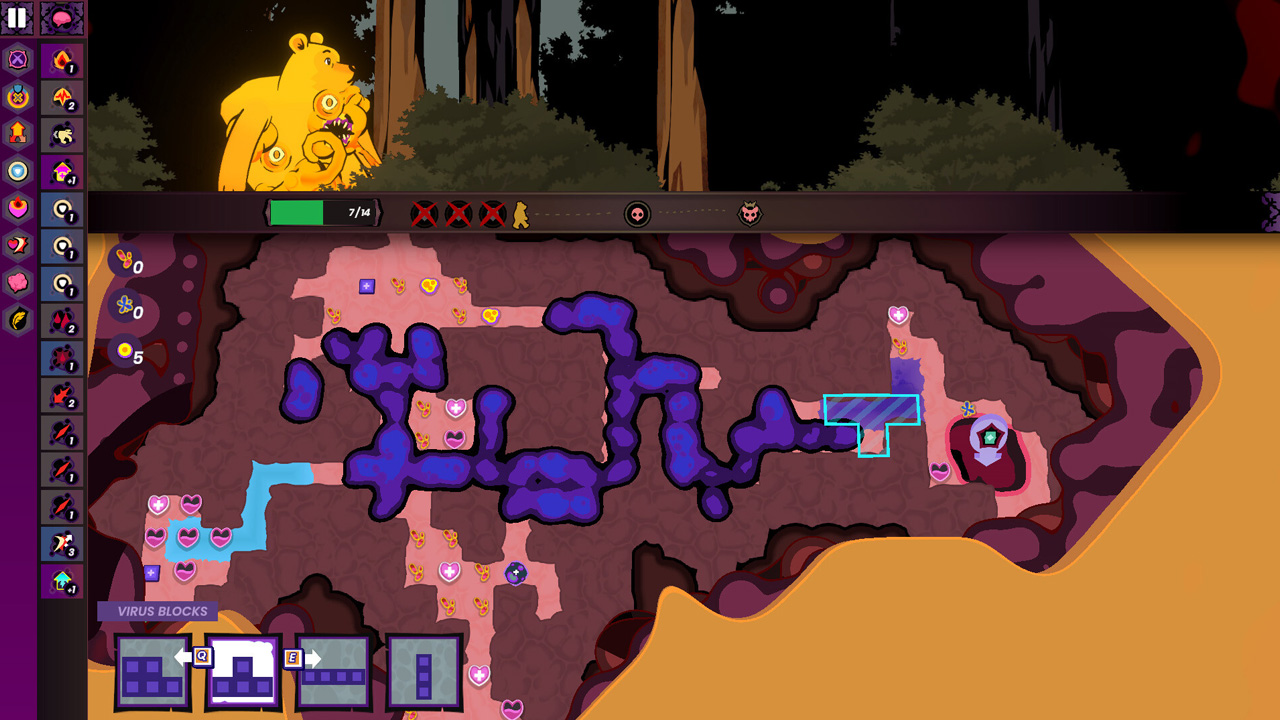
The game’s structure will feel familiar if you’ve played Ring of Pain, but the mechanics pivot in a bold new direction. Twice Different retain their signature ability to twist something visually cute into something deeply unsettling, but the card-based systems are gone. In their place are Tetris-like pieces that slot into a grid representing Pooh’s internal systems (brain, guts, and everything in between).
In combat, you build out the brain grid to determine the actions Pooh is forced to perform, including attacks, defences, mutations, and stranger effects that can completely reshape a run. It’s immediately readable, but the best builds come from experimentation. You find combinations that synergise, then decide what to keep, evolve, or tear out before it ruins your strategy.
Between battles, those same pieces are used in maze-like exploration sections within Pooh’s guts to gather health, currency, and virus points. These resources feed into shops, upgrades, mutation management, and eventually research systems that expand both your options and the game’s narrative depth. It’s a loop that feels strategic without being overwhelming, and experimental without becoming messy.
Narratively, the story unfolds through in-combat dialogue and cutscenes that often raise more questions than they answer. The mystery surrounding your origins and what exactly is happening to Pooh creates a steady pull forward. The game rarely over-explains itself, instead rewarding curiosity. Combined with the addictive rhythm of experimentation and progression, it becomes very easy to say “just one more run.”
That said, it’s important to remember this is Early Access. While the core systems and main story framework are in place, there is clearly room for growth. More virus strains, mutations, enemies, bosses, secrets, and quality-of-life improvements are planned. At times, you can feel the edges where systems could deepen further, but encouragingly, it reads as potential rather than absence.
Winnie’s Hole is already clever, unsettling, and mechanically engaging. More importantly, it feels like a foundation for something even stronger. If Twice Different continues building on what’s here, this could evolve into one of the more memorable horror-strategy indies in recent years. And yes, that sentence was intentional.
